
Review of Thank You Lord for Everything

Well, as you can see in my last post I’m officially a new daddy now which means one thing–I’ll probably be reviewing a lot more children’s books. Even if you’re not a parent, if you have nieces, nephews, grandchildren, or friends with young ones, you might want to read these and if there are good books out there, to give them the gift of knowledge and wisdom in addition to the toys and clothes you’re already giving.

One hard truth I’ve realized as I’ve become a father is that just in my lifetime we’ve gone from a society that embraced Christianity, to one that was ambivalent about it, to one that tolerated it, to one that is increasingly openly hostile to it (especially in places like where I live in the New York City area). We’re seeing history repeat itself again as Christians outside our country are tortured an murdered for their beliefs, and Christians inside our country are denigrated, despised, and stripped of their livelihoods and their reputations if they dare to come out of their “closet”.

And so how do you combat this? The old adage is true–the pen is mightier than the sword. Gutenberg revolutionized the world by publishing the Bible–for the first time in 1500 years people could hold the Word of God in their own hands. And so it is with the children of our society today.

And so I’m looking for good books that teach eternal truths, preferably not insulting their intelligence nor beating them over the head with dogma, but letting God’s word speak for itself.

And with that, I’ll turn to today’s book. Thank You, Lord, For Everything from the wife and husband writing and illustration team of PJ Lyons and Tim Warnes.

I have to say, I loved this book in so many ways. It seems that merchandising of characters has become the only way we can shop for children these days. All you can find are Mickey Mouse blankets, Cookie Monster diapers, Snoopy pillows, Bugs Bunny band aids, and so on.

The illustrations in this book by Tim Warnes are the star of the show. The main character of the book isn’t a “star”, he’s just an adorable little bear just going through his daily life of waking up, eating breakfast, playing with friends, and having a picnic. The illustrations are colorful, bright, and as you can see in this example has details that will engage youngsters.

cute christian childrens book

The story by PJ Lyons consists of simple and short rhymes where the little bear realizes that he can give thanks for all the wonderful things in his life.

What I love about this book is that it teaches 1 Thessalonians 5:18 without even having to cite chapter and verse. It shows this cute little bear living it out, understanding the lesson we grown-ups often forget that everything wonderful in our lives is given to us by God and that with a humble heart we should give thanks, not just mouthing the words when saying grace but by experiencing them in our lives.

As a father, something else I really appreciate is an appearance from the little bear’s dad, pouring juice for the little guy at breakfast time and spending time to play with him later in the book. It’s sad that the appearance of a good father role model seems to be so rare these days in portrayals of families in media (more often than not, the dad is either bungling or absent altogether), but I was happy to see it here.

a good dad in a childrens book!

The hardcover book is solid board book with 16 pages and full color throughout. The cover is thicker, padded stock. While the age range says 4-8 years, I think 8 might be a little too old–it’s definitely a book for much younger children from, say, 3-6–from 3-5 you’re probably going to be reading it to him but by age 5-6, he should start being able to read some things for himself.

Sometimes Christian children’s books seem a little like they’re trying too hard to get children’s attention with gimmicks like stickers or attempting to take adult concepts and “dumb them down” for kids. Where I love this book is that it’s simple and tells a wonderful story using natural language and concepts that small kids can understand, with a simple message that will be one of the most powerful for them if they can continue to practice it growing up.

This one is very highly recommended, it’s one of the top children’s books I’ve reviewed to date. and one I’ll definitely be sharing with my little one, hopefully over and over again.

Review of Seven Women and the Secret of their Greatness

The first book I reviewed on this blog was Eric Metaxas’s Seven Men and the Secret of Their Greatness. It’s only fitting that I review the new companion book called Seven Women: And the Secret of Their Greatness.

As with the 7 Men book I’d categorize this book as a modern-day sequel to Hebrews 11. It recounts modern day heroes of faith and gives us condensed biographies of their lives that, while short, still feel remarkably comprehensive.

The women highlighted here include Joan of Arc, Suzanna Wesley, Hannah More, Maria Skobtsova, Corrie ten Boom, Mother Teresa, and Rosa Parks.

As I found with the 7 Men book, once I started reading the accounts it was hard to put them down. For one thing, given my 21st century attention span I knew that I wouldn’t be spending weeks or months getting through it. But more importantly, Metaxas’s writing is more conversational and flows more naturally than your typical heavy biographic tome. If you’ve ever heard his podcast/radio show (which I highly recommend), you’ll recognized that he writes with the same natural flow was he speaks with.

The story of Joan of Arc is a good example of one where I’d heard the name before but never really knew much about her, even to the point of wondering if she was a real historical figure. Although admittedly I was better than my wife who heard me mention her name and asked “was that the wife of Noah of Ark?” But I think both of us are probably better than those who confuse her with Knot’s Landing’s Joan Van Ark.

Metaxas goes through the entire history of Joan of Arc from her childhood to her life of prayer to her visions to her eventually leading a armies for France against England and to her ultimate demise in a story that’s been repeated many times before and since–a lone figure standing up for what she believed in ultimately condemned by the mob of those unable and unwilling to even try to understand her.

What I really love about the way Metaxas tells it is that he doesn’t interject the account with commentary or interpretation or revisionism. He just tells her story uninterrupted and lets you draw your own conclusions.

Even though it happened 500 years later, his recounting of Rosa Parks’ story is just as compelling. Revisionist historians talk about civil rights figures such as Rosa Parks and Jackie Robinson as the heroes they are, but what’s mentioned less and less as the years go by is how much a role Jesus Christ played in their lives. In fact, both became heroes not just because they stood up alone against a culture that tried to intimidate and bully them, but because they did it with Christ-like humility, faithfulness, and gentleness.

All of these stories follow a similar pattern of women in the face of insurmountable odds finding the strength in God and in themselves to persevere and conquer. It’s a great book to share with the young tween or teen girl in your life to remind them that yes, there are amazing female role models in this world that they can follow as alternatives to the Kardashians, Cyruses, or Grandes that the world expect them to follow.

Review of NIV Zondervan Study Bible

The last time I purchased a Study Bible was my ragged NIV Study Bible from 1985. How the times have changed since the days of digital printing.

At 2880 pages, NIV Zondervan Study Bible is easily the most comprehensive Study Bible on the market today. They’ve made the pages thin, the typeface small, and the typeface of the study notes even smaller but still it weighs in at almost 5 pounds. Here are some of the things I love about it:

1) New typeface. After years of publishing Bibles in standard Times New Roman, the new typeface appears to be in the Garamond family, which I find much more friendly and readable.

2) Full color. Unlike Study Bibles of yore which relegated the color printing to the maps at the end, every page of this Bible uses 4-color printing, meaning you’ll have things like green-colored chapter numbers and headlines, light green background for the Study Notes section on the bottom of each page, full-color illustrations and tables. They don’t use color for the sake of color but only as it augments the reading experience. And yes, the maps that we all took imaginary journeys on during those slower-moving sermons are still there

3) Illustrations. Speaking of illustrations, they too are phenomenal. There are full color photographs of relics and artifacts that really make the Bible text come to life (Isaiah 47 which talks about the fall of Babylon shows an artifact from the British Museum from Assyria depicting the event; next to 1 Thessalonians 4:5 shows the remains a first-century bath that was next door to a brothel, and so on).

4) Each book of the Bible has an extensive introduction that speaks to the books’ authorship, date, audience, historical setting and purpose, literary features, theological significance, and a concise outline of the book. The commentary to introduce each book for the most part seems balanced and fair.

5) The back of the Bible includes a number of articles on various spiritual topics from various authors. Again, for the most part these articles appeared comprehensive and well-researched in discussing not only the topic but also approaches to studying the topic.

6) The book is solidly constructed, not a small engineering feat for such a large volume. It’s not the type of Bible you’ll be lugging around to church every week, but that’s not what it was designed for; for me, it’s a great reference to have for when I need it. And I was pleasantly surprised to see that every copy has an individualized card at the end that lets you enter a code to download the digital version, which does solve the portability challenge.

7) With goes without saying that the maps, concordances, charts, timelines, illustrations, and photographs are excellent, on par with what youd’ find in most standalone volumes.

If there is one gripe I have about this book it’s in the commentary. Where the commentary sticks to historical facts and background I love it. But flipping to a couple of the verses that different Christian denominations typically disagree on, I find that in most cases only one perspective and interpretation is espoused. Given that this is a Bible, a casual reader might conflate the commentary with the Word itself.

While I don’t blame the editors for taking this approach–by definition the entire notion of commentary in a Study Bible is for it to be one person or one group’s interpretation (i.e. opinion) and including every opinion would have doubled the size of the volume–I would have much preferred a much more balanced approach, especially for some of the verses that have to do with doctrines with which different denominations may differ. One example of this is Acts 2:38. The commentary unequivocally states that this verse does not mean that the actual act of baptism saves and implies that it is merely an outward act. It also seemed to imply that the apostles baptizing “in the name of Jesus” was merely shorthand for the more proper Trinitarian formula. Again, while good people can differ on precise interpretation, I would have liked to see a more balanced and measured approach, something I’d seen in earlier versions of the NIV Study Bible but which unfortunately I see less and less of recently.

Still, if you’re a serious student of the Bible, this is a volume I highly recommend having in your library provided that you use it as a reference and starting point for your own studies and not a replacement for them.

Review of the Berenstain Bears Storybook Bible for Little Ones

Most of us who were born after 1962 knew the Berenstain Bears well, even if we never quite mastered how to spell or pronounce their names. Stan and Jan Berenstain created the bear family that year and the bears took off when none other than Theodor Geisel, Dr. Seuss himself, included the Bears in his Random House Beginner Books series. Close to 260 million copies later the Bears are still a part of our culture.

Stan Berenstain passed away in 2005 and then Jan passed in 2012. But unlike cartoonists like Charles Schulz and Dr. Seuss, whose creations essentially stopped when they passed on, and unlike cartoonists like Walt Disney and Jim Henson, whose characters are living on with arguably much different personalities than before, the Berenstain Bears continue pretty much the same as they always did. This is largely thanks to Mike Berenstain, the son of Stan and Jan who continues to write an illustrate the books that his parents had started when he was 11 years old.

Over the years, some have criticized the Bears as being too saccharine or namby-pamby. But in a world today that’s so filled with terror, and angst, and hatred, and cynicism, maybe a little sweetness couldn’t hurt. Not to say I’m going to go out and collect all fifty gazillion versions of the books including “The Berenstain Bears and their XK-E”, but on the other hand I wouldn’t mind inviting the Bears in for the occasional bedtime reading.

In a rather bold move, in 2008 Mike Berenstain started to introduce book featuring the Berenstain Bears with overtly religious messages, published by Zondervan. While the Bears books always instilled good values and taught moral lessons without being overly sanctimonious, this move seemed to fly in the face of the trends of the world; I remember last Christmas I saw a restored version of “The Little Drummer Boy” for the first time since I was a kid and was amazed at how overt the Christian message was and realized that this should could never be shown on network TV again. And I was saddened to see how those who acquired the rights to VeggieTales somehow felt it necessary to make Bob and Larry into a secular cartoon show.

What’s nice about the Zondervan series of books is that it bridges the same gap that believers need to bridge. As in the “secular” Berenstain Bears books, when we’re out in society we need to reflect our Christian values in our daily lives (living in the world but not of the world), but that don’t necessarily mean thumping a Bible everywhere and trying to baptize everyone everywhere we go.  On the other hand, as Christians we do need to spend time in devotions with God and in His Word, and that’s where I see the “Living Lights” series of books going. As much as the world thinks it needs to paint things into a “secular” or a “religious” box, the truth is, like with the Berenstain Bears, we can be both, shining a light in the former and being a light in the latter.

The Berenstain Bears Storybook Bible for Little Ones (Berenstain Bears/Living Lights) is a bit more advanced than the previous book I reviewed; this one contains very simple prose that you can read to your child or have him or her read to you. As with the  last book, this one isn’t a “Bible” so much as a collection of seven stories from the Bible (Creation, Noah’s Ark, David and Goliath, Daniel in the Lion’s Den, the Birth of Jesus, the Good Samaritan, Jesus in Jerusalem, the Resurrection).

The illustrations are typical for a Berenstein Bears book–they feature the Bears playing the parts of the different Bible characters and there’s a lot of detail for you to point out with your child. The book is hardcover, about 5 x 7 x 1, and had nice thick card stock pages for durability.

The stories are all simplified versions of the Bible stories and are mostly accurate. I did see some minor instances where some embellishment was made. For example, in the story of Daniel and the Lion’s Den, it says that Daniel pet the lions. In the story of Jesus’s death, for obvious reasons they didn’t get into a lot of details, but the entire crucifixion was summed up in the sentence “But the soldiers did hurt Jesus. Jesus was sad, but reminded them, ‘God loves you.'” Again, it’s a tricky thing to be able to communicate to a young person, but in some ways I felt it a little too simplistic.

That said, all in all this is a solid effort by Mike Bernstain and an excellent way to help introduce your children, especially those who are already familiar with the Bernstain Bears, to the Bible, whether you’re a devout Christian or just someone who would like to instill Christian principles of love, humility, and faithfulness to the next generation.

Review of Say & Pray Bible

On August 4, I became the proud daddy of baby Madeleine. Thank God, while she came about three weeks earlier than expected, mother and baby are doing just fine. I’m still taking in all the emotions and experiences that come with fatherhood, and something tells me there’s a blog post ahead on the subject (that for the first time in a while won’t be a book review). Stay tuned for that 🙂

I’ve been reviewing a lot of grown-up books, but with the arrival of baby girl I’ll be looking for children’s books to review. In many ways, the need for great Christian children’s books is more critical than ever.

We live in a world where it’s harder than ever for new parents to raise their children in Christ. I have to admit, that’s one of the things that terrifies me most as a new parent. The United States I grew up in was still at its core a Christian nation–even though they weren’t teaching the Bible in schools there was basic agreement of civics and morality that was shared between parents, the schools, and the church. And they happened to coincide with the teachings of Christ. Love thy neighbor. Do unto others as you would have them do unto you. Blessed are the peacemakers.

But somehow in the last 50 years even those things that seem to have been common sense are now somehow controversial. What at one time had been a partnership between parents, schools, and church now is now anything but. Parents distrust schools because they feel certain educators are more interested in pushing a social agenda than teaching their kids. Schools distrust parents because so many of them fail to discipline their kids at home leaving it to the poor teachers to deal with it. The church in far too many cases grows more and more irrelevant because they become too insular and irrelevant to the needs of their congregations at a time when their congregations need them the most. And of course, the child is the one hurt the most in all this.


As a parent, I know I can write off the schools as a place where my little girl is going to learn basic morals or civics. I’m going to keep praying that my church continues to examine itself and becomes the kind of place that my little girl can really experience the love of Christ in. But I realize that the bulk of the responsibility is going to be on me, as it should be, to model for her what Christ’s love is all about and to teach her as much as I can.

It’s because of this that I’m thankful for books like the one I’m reviewing today, the Say and Pray Bible: First Words, Stories, and Prayers by Diane Stortz with illustrations by Sarah Ward.

The book is just the right size for little hands; about 5 x 7 x 1 inches.  The book is beautifully illustrated throughout. It’s perfect for toddlers aged 3-5 who are just learning how to read; on each page there’s a title, a 2-3 sentence “story”, and about 7-10 word bubbles that accompany the colorful illustrations.

To call this book a “Bible” is a bit of a misnomer, but I think the author and publisher probably used the word figuratively. The book does go through 20 child-friendly stories in the Bible (Adam and Eve, Noah’s Ark, etc.). There are no more than 20 words on a page, so this is less a storybook than it is a book for you to read along with your toddler as he or she points out pictures together identifies and learns individual words like the names of animals or Bible characters. The onus is really on you as the parent to know the stories in advance to describe the illustration or in case your inquisitive little one starts asking questions about it.

The pictures are wonderfully drawn and will be appealing to most children. The animals are cute and scenes are all simple yet beautifully colored. The Bible characters are cute without being inaccurate (the picture of the Good Samaritan shows him of a different skin hue than the others; characters like Abraham and Ruth wear simple clothes and sandals; Joseph’s coat of many colors is really, really colorful; and so on).

Each story also has a Bible verse associated with it and a short one-sentence prayer (the “say and pray”). It’s of course not deep theologically, but does start to introduce your toddler to the concept of reading the Bible and prayer. Of course whether our toddlers continue this depends largely on how much we do it ourselves.

The book is a “board book” so each page is made of thick, durable card stock. The cover is even a little plush. The book is solidly constructed and will almost surely become a favorite of your toddler.

What I love most about the book is that it really is age-appropriate–it steers clear of theology and deep exegesis and controversial topics and sticks with something really simple and basic–simple illustrations that will help you tell stories from the Bible.

This is definitely one I’ll be reading with my little one, and hopefully many times. Highly, highly recommended.

Bonhoeffer: Pastor, Martyr, Prophet, Spy (Student Edition)

Bonhoeffer: Pastor, Martyr, Prophet, Spy Student Edition is, as you can guess from the title, the student version of Eric Metaxas’s Bonhoeffer: Pastor, Martyr, Prophet, Spy.

As I’d mentioned in my first book review, I’ve been a fan of Metaxas for years, the first few years without even knowing it. I was in my twenties when I encountered the first oeuvre of his to have a profound impact on me: an early episode of VeggieTales.

Since then I’ve read a couple of his other books. But it’s always been on my list to read this Bonhoeffer book, a book that’s been critically acclaimed, is a best seller, and word is that it’s being made into a movie.

I was a little skeptical when I saw that a student edition of the book was coming out–it’s not uncommon for book publishers to take a successful book and churn out special edition after special edition to squeeze as much profit as they can out of it. But when I saw that Metaxas himself had written it, I had to take a look.

As I expected, this edition is exceptional. It’s no “Reader’s Digest condensed version”, it captures the most important facts and stories in Bonhoeffer’s life from the main book using language and a narrative that is understandable by students without talking down to them. While the publisher isn’t clear about the age range of who should be reading this, personally I’d say anywhere from grade 6 to grade 9; anything after that and they probably could be reading the regular edition.

Something else I appreciate are the call-out boxes–unlike in other books they’re not just pedantic filler but really interesting definitions and facts that are relevant to the text; things like the lyrics of Luther’s “A Mighty Fortress is Our God”, juxtaposed with a passage describing how the faithful in Germany defiantly sang the hymn as bishop Ludwig Muller started to impose Nazi rules into the German church. Another call-out box describes grocery prices in 1923 in the USA compared to Germany after Versailles.

I also appreciate the questions at the end of each chapter. They’re not just there to test reading comprehension, but to inspire thought, introspection, and ultimately life application on what was just read. One of the questions, for example,  asks students, “Niemoller said, ‘No more are we ready to keep silent at man’s [request] when God commands us to speak.’ Have you ever kept silent about something you knew was wrong?”

While this book was designed for students, I have to admit just as I was a guy in my 20s singing along to VeggieTales, I’m now a guy in my 40s reading books for teens and tweens. I think this says something about Metaxas and his ability to reach any audience (speaking of which, if you’re not listening to Metaxas’s radio show, you’re missing out). With so many other books designed for tweens and teens speaking down to them, this one actually gives them the credit they deserve, and goes beyond a history book to one that can help them think through the life of Bonhoeffer and apply it to their daily lives.

Review of NIV Dad’s Devotional Bible

I was excited to see the NIV Dad’s Devotional Bible become available. As a soon-to-be-new-dad, and a first-time dad to boot, I figured I could use all the help I could get.

I think I mentioned in an earlier post that these days you can get a Bible for just about anything. In the old days you’d buy different translations like KJV, NIV, NKJV, RSV, and the whole other alphabet soup of versions. But then Zondervan got clever. They’d take the regular Bible and create versions for niche audiences. There are study Bibles, Bibles for leaders, for moms, for students, for teens, for ministers, for kids, for those suffering from illness, for those recovering from illness, for the military, for weddings, for gardeners, for music lovers, and a ton more.

At first I welcomed this trend; after all, there’s no harm in getting more Bibles out into the world, and these things can make great gifts for people in certain situations. But I have to admit I’ve been a little disappointed at the last few of these “specialty” Bibles I’ve read. I do appreciate Study Bibles where each page is annotated with information and commentary that helps you understand the passages you’re reading better. But in the case of a lot of these specialty Bibles, the content could very well have been published as a separate book. In fact, it probably would have been better published in a separate book.

This Bible is a classic example of this. There are 260 devotional readings scattered throughout the book, but it seems more like two books awkwardly mashed together rather than content that’s really integrated; as you read the Bible occasionally you’ll get interrupted by a page with a devotional; conversely, the devotionals say “skip to page 505, skip to page 515, skip to page 526” so the contents of the Bible almost seem to get in the way.

As for the devotionals themselves, while they’re tangentially related to the Bible passages they’re juxtaposed with, in some cases I think the connection is a little too tangential. In most of the devotionals the personal stories the author recounted of his and his family’s life for some reason didn’t really resonate with me. Just as a random example, in the devotional next to Acts 8:26-35, the author starts out by talking about how he in college agreed to act in the play The Fantasticks. He talks about how he got onto the stage and was excited that “it was showtime”. Then he abruptly cuts to the account of Philip and the Ethopian and talks about how that moment was “showtime” for Philip. Yes, I see the connection, but it seemed just a little bit of a stretch for me. Your mileage may vary of course. I definitely encourage you to use the “Look Inside” feature of Amazon to see if the writing resonates more with you than it did with me.

For a Bible like this, I would rather have seen a collection of authors rather than one author. Reading account after account of this author’s own life got a little repetitive after a while; I would have like to have seen accounts from different fathers with different kinds of kids. I also would have loved to have seen practical advice I could have used in teaching my kids the Bible; next to the account of Noah’s Ark, instead of a piece that talks about, say, creative ways to introduce a child to the story, there’s inexplicably a devotional talking about the 1984 Cubs (again, he made it technically relevant but it still seemed like a stretch). Bottom line, I would have liked it to have been a little more relevant for my daily needs as a new father.

That said, I did love this Bible once I got to the end, at page 1411. There are a couple pages that give brief synopses of each book in the Bible and talk about their relevance to dads. On page 1429-1467 there’s a section on typical Bible-related questions that kids ask, and while I don’t necessarily agree with all the answers they do provide good reference.  The last section is one that provide a topical index relevant to each of the fruit of the Spirit, an interesting addition but one that I’m not sure is the most relevant thing to dad’s Bible there could have been. It seemed a little more like filler.

Bottom line, the Bible itself of course gets a 10 out of 5 stars, but this compilation gets about 3 of 5 for me. Again, this is just me, so I definitely encourage you to take a look for yourself.


Review of Really Woolly Nighttime Lullabies

The book I’m reviewing this month is Really Woolly Nighttime Lullabies. It’s a cute little hardcover board book that’s about 40 pages long. It’s sturdy and its pages are all thick cardboard-like stock, making it an impressively durable book. That, plus the fact that it’s about 6 inches by 8 inches make it an ideal book for a little ones. The book is ideal for toddlers or children 3-5.

The book is beautifully illustrated with full color pictures throughout. For those familiar with the Really Woolly series that’s been around for 15 years, you’ll notice pretty much the same pattern. There are lots of really cute drawings of the sheep character, along with friends like bunnies, baby ducks, fireflies, squirrels. In this book they’re doing fun things like hiking, blowing bubbles, looking at the stars, and camping out in the backyard. The drawings alone are beautiful and full of detail that will definitely capture a youngster’s attention and imagination. On the facing page of the illustrations is a title, a bible verse, and a poem, with a little one-line prayer under the illustration.

If there’s one slight gripe I had about the book it’s the poetry. The title is a little misleading–while it says it includes “lullabies”, what’s really included are three-stanza poems that rhyme. That’s actually counter to Webster’s Dictionary, which defines a lullaby as a “song used to help a child fall asleep”. In a way it’s showing the age of the Really Woolly series–they’ve already done Bedtime Prayers, Bible Stories, Bible Verses, Bible Promises, and Treasury, so it could be they’re just running out of “Bedtime” ideas.
There’s nothing wrong with the poems of course, and they do all have a calm, soothing quality about them. On the other hand some of them seem to lack substance almost to the point of being vapid. “Dream of kites and red balloons / butterflies and happy tunes / bunnies racing through the yard / sparkly sky so brightly starred”. Again, not horrible, but at times it seems like the authors were stretching to find a way to tie together words that rhymed as opposed to really writing a cohesive and substantive poem. Granted it is written for young children so I’m not expecting theological depth, but on the other hand I almost wish this could have been a book with real songs like “Jesus Loves Me” and “Jesus Bids Us Shine” with the Woolly gang.

Still, as with all the other Really Woolly books this one is beautifully drawn and produced, and one I’d recommend to parents. That said, I’d probably buy one of the earlier version before picking this one up if you want a good introduction to the series. I’d rate this one 3.5 out of 5 stars.

Review of Words to Dream On

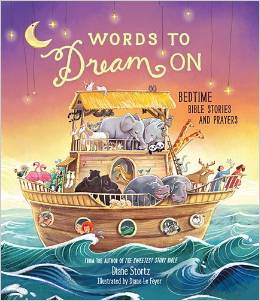
words to dream on childrens book reviewIt can be difficult to shop for Christian reading materials for children and toddlers. In some cases the material is too watered down–being so subtle in its message that it’s hard to tell if it’s from a Christian or a secular worldview. In other cases the material can be too deep–there may be a time to expose children to esoteric theological material, but perhaps not as a baby or toddler.
Out of all the children’s books on the market, the one that jumped out at me as I tried to “judge a book by its cover” was Words to Dream On: Bedtime Bible Stories and Prayers by Diane Storz (illustrated by Diane Le Feyer). The book itself is a beautiful, full-color book from cover to cover, with hardcover binding. The first page has an area where you can write your name, the child’s name, and the date if you give the book as a gift to a child, grandchild, nephew or niece, or friend.

The book is divided into 26 stories from the Old Testament and 26 from the New Testament. The stories are arranged by the order they’re presented in the Bible, started with the Creation and ending with an entry called “Forever with Jesus” based on Revelations. In the middle, of course, you’ll find stories you expect, such as Daniel in the Lion’s Den, Noah’s Ark, and many stories of Jesus from the Gospels.

Perhaps the most remarkable thing about this book is that the author didn’t see a need to embellish the stories. As I read through the stories, while the stories are of course rewritten in simple language for children, I don’t see anything that contradicts the original text of Scripture. To the contrary, the stories are very true to the stories of the Bible. For example, take this passage from the Parable of the Prodigal Son:

Here’s how the passage reads in this book:

“Here’s your food, piggies,” he said as he poured messy pig food into feeding troughs. He felt so hungry, though, that the messy pig food began to look good to him, and he thought about eating it himself.” Then he had an idea. “I’m a hired worker with nothing to eat,” he said, “But my father gives plenty of food to his hired workers!”

And here’s the source content:

So he went and hired himself out to one of the citizens of that country, and he sent him into his fields to feed swine. And he would have gladly filled his stomach with the pods that the swine were eating, and no one was giving anything to him. But when he came to his senses, he said, ‘How many of my father’s hired men have more than enough bread, but I am dying here with hunger!’

The illustration are also remarkably true to Scripture as well, as far as I can tell. In the Christmas story, you don’t see wintry scenes of snowfall. Illustrations of most characters throughout the book are of people with dark hair, darker skin, and beards of the kind you’d find in the Middle East, not to mention fairly accurate (for a kid’s book) depictions of the kinds of clothes, marketplaces, pottery, and animals. In the story of Jonah, you don’t see a picture of a smiling whale but rather an illustration of a tail of a “great fish”. The one exception, not all that surprisingly, are illustrations of Jesus, where He’s still depicted with white skin and brown hair; granted no one knows what He really looked like on Earth, so the illustrator probably figured it was better to stick with the typical images.

Something else I loved was that each story concludes with a short “Sleepy-Time Prayer” and “Bedtime Blessing”. If I had one wish it’s that the prayers were just a little longer than the 10-15 words and the blessings were a little longer than the 5-7 words. But then again, it might be for the best if you as a parent can come up with your own prayer to share with your little one.

Overall, I was pretty impressed with this book. The book itself is solid–the hard covers are thick and durable, and the pages inside are thick and in beautiful full color which will hold the attention of your little one. It is a great way to introduce your little one (and re-introduce yourself) to the stories of the Bible.

Review of Nelson’s Illustrated Bible Dictionary

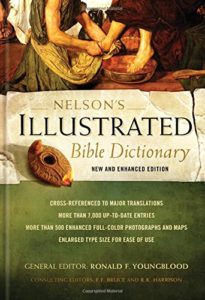
nelson bible dictionary reviewMost of us, when we do daily Bible reading, just read through the passages quickly without stopping much. We’ll come across certain words and our brains will draw a certain conclusion about what that word means.

My favorite example of this is the word “manger”. We all know the song “Away in a Manger”, but the scene that comes to most of our minds is a traditional nativity scene where all the shepherds and sheep and Mary and Joseph are all gathered around the baby Jesus, peacefully sleeping in a bed of straw. But looking up the word in the Nelson’s Illustrated Bible Dictionary, you read this as the definition:

MANGER – a feedingtrough, crib, or open box in a stable designed to hold fodder for livestock (Luke 2:7, 12; 13:15). In Bible times, mangers were made of clay mixed with star or from stones cemented with mud. In structures build by King Ahab at Megiddo, a manger cut from a limestone block was discovered. Mangers were also carved in natural outcroppings of rock, such as livestock being stabled in a cave; some were constructed of masonry. 

The definition goes on to describe each time the word is used in the Bible. Understanding the true meaning of the word suddenly brings the context of the Word alive. The physical place that Jesus was born wasn’t a pristine scene where you could hear “Silent Night” playing in the background. It was obscure, anonymous, and probably dirty and smelly. But that’s kind of the point. Jesus’s entire life on earth was one where He has “nowhere to lay His head”, but His whole life pointed to a new, spiritual kingdom that was not of this world.

It’s really interesting to go through the Bible Dictionary and look up other words you always assumed you know what they meant. It’s also fascinating to read up on the background of cities like Ephesus, Corinth, Galatia, and others to provide you context before you read about them in the New Testament.

The Dictionary is substantial. It comes in at over 1200 pages. The paper is thick and the typeface is relatively large and readable. The language isn’t scholarly nor esoteric but easy to read. The pages are all in color with plenty of photographs of artifacts, archaeology, present day photographs of geographical locations, and diagrams (there’s a topological diagram of the path that the Israelites took in Exodus that really helps you understand their wandering in the wilderness, and the beginning of the book are timelines covering the entire Old and New Testament periods in vastly greater detail than you’ll find anywhere else). Entries about the Books of the Bible contain an outline of the book you can use while studying it.

I literally couldn’t think of a Bible-related term that wasn’t covered in the book. One other thing I like about the book is that it attempts to be objective when covering “controversial” topics which different denominations have disagreements about. It lays out the viewpoints of at least the major denominations in a way that doesn’t seem to be pushing one or the other. For example, my own church has a rather conservative view about baptism, and yet reading the entry on baptism, I wasn’t offended or put off, but I found it interesting to read, without the fog of argument nor over-enthusiastic proselytizing, the viewpoints of others.

Overall, this version is a fantastic improvement over the last version, and I’d say it’s a must-have if you’re serious about digging deep into your Bible study. And call me old-fashioned, there’s something nice about having this all in a book you can hold in your hands as opposed to scattered all over the Web.

One thing to be aware of is that you’re buying the most recent version, dated 2014 and named “Nelson’s Illustrated Bible Dictionary: New and Enhanced Edition“. There’s an older version named “Nelson’s New Illustrated Bible Dictionary: Limited, Deluxe Edition”.